Archive for the ‘Uncategorized’ Category

ACE’s 18th Annual IAVA (Invisible Art/Visible Artist) 2018

Wednesday, June 13th, 2018

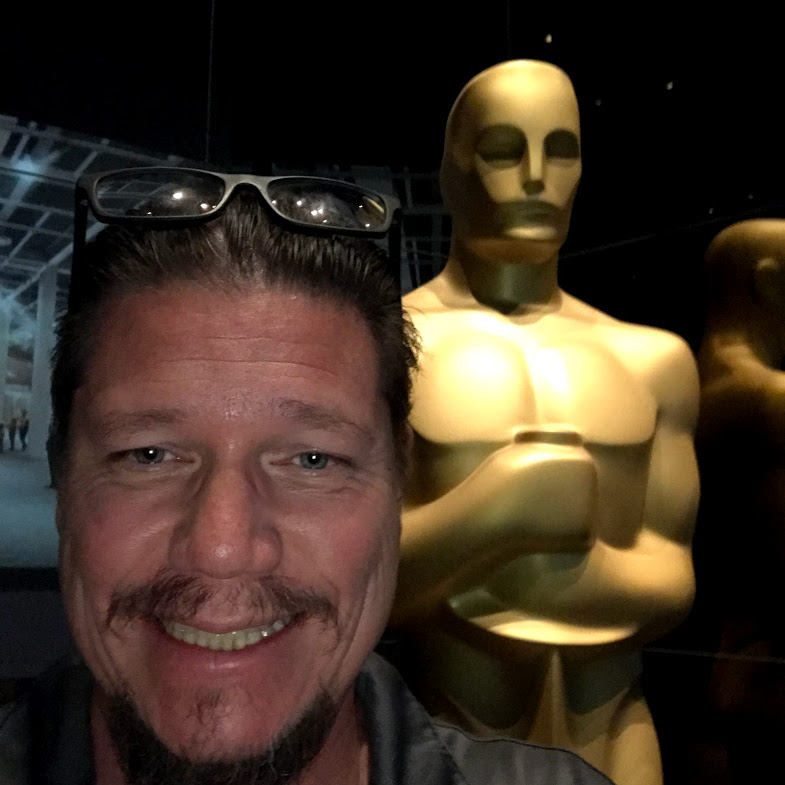
On March 3rd, 2018, I attended my 10th ACE Invisible Art Visible Artist event. Each year the line to get in seems longer and longer. I think has a lot to do with the fact that ACE is steadfast in their efforts to help our craft in being recognized in the world of film.

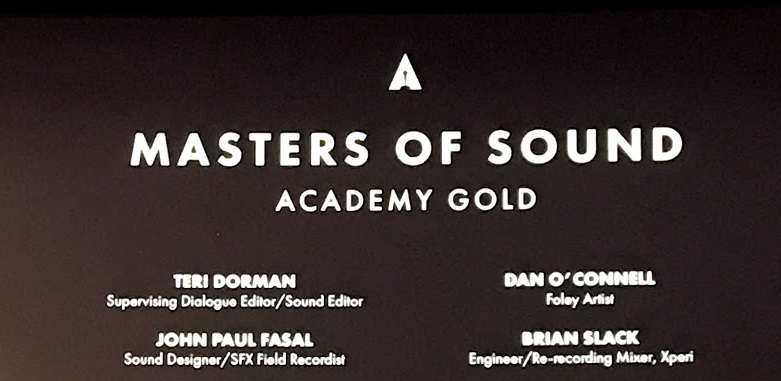
IAVA (Invisible Art/Visible Artist) is the panel where all of the year’s Oscar nominated editors come together and speak about how they got into the craft and what it was like to work on their particular film that has been nominated. Some years not all of the editors can make it but this year we were lucky in that all of the nominees were present. Although, Tatiana Riegel had to leave early because she had to attend the Independent Spirit Awards*, where her film I, Tonya was nominated in three categories, including Film Editing, which she won.

The editors and movies nominated for an Academy award in Best Achievement in Film Editing were Tatiana S. Riegel, ACE for I, Tonya; Jonathan Amos, ACE for Baby Driver; Paul Machliss, ACE for Baby Driver; Lee Smith, ACE for Dunkirk; Sidney Wolinsky, ACE for The Shape of Water; and Jon Gregory, ACE for Three Billboards Outside Ebbing, Missouri.

The MC of the event was perennial Alan Heim, 1980 winner of the Best Film Editing Oscar for the 1979 film, All That Jazz, and Vice-President of the American Cinema Editors and President of the Motion Picture Editors Guild.

There are a myriad of ways that people get to editing as a career. Each year we hear a sample of how the best of the best came to arrive at their positions.

Ms. Riegel’s story was “edited” down. After graduating college with a political science degree, Howard Smith gave her, her first job on the film River’s Edge. She credited him with teaching her a lot. “And I’ve been working ever since.”

Jonathan Amos’s story wasn’t quite so short however. He taught himself the Avid and eventually traveled the world making documentaries, determined to edit any possible way he could. During that time, he was offered an assistant job at Ealing Studios on a TV show where Edgar Wright happened to be shooting Shaun of the Dead. Jonathan got to meet Chris Dickens, whom would go on to win the Oscar for editing Slumdog Millionare. Chris and Edgar reached out to Jonathan to help on Hot Fuzz and then Scott Pilgrim vs. the World, where he reached his dream of becoming a film editor.

Regarding advice for new people striving to become editors, he added, “desire, courage, and luck. That’s what I say to anyone that comes into the cutting room, ‘you’ve got to apply yourself so much’. And I can tell the assistants that are going to make it because they want it, they’re so hungry…. And that was me back then. I see that hunger and yeah, that’s what you gotta do.”

Paul Machliss came from Australia and knew he wanted to be in films from the age of 5 or 6, when he accompanied his father, a producer, to an editing session one day and fell in love. “Whatever is going on in this room, I want to be a part of it!”

He went from an internship to a job at a television station, just prior to going to University and never went back. Although he jokes that Uni’s still on hold, “just in case this doesn’t sort of work out!” A chance job opportunity to demo some Sony gear at IBC, prompted him to extend his trip further to London because he was a big fan of British comedy and wanted to be a part of that world. He literally knocked on doors until he landed an editor job. Eventually, he got on the show Spaced, where he worked with Edgar Wright on-lining the first season. He then wanted to freelance and as Chris Dickens wasn’t able to do the second “series”, Edgar hired him for it. He now had really reached his dream of working in England on British comedy shows. In 2009, at Edgar’s behest, he joined him and his friend Jonathan Amos on Scott Pilgrim.

Lee Smith began working in film in 1976, his family was in the industry and he “just didn’t have a choice!”, he jokes. His father was an optical effects technician at a film lab in Australia and his uncle co-owned a lab and his auntie was a neg matcher and his brother was a camera man.

In an uncertain time for film in Australia, his father helped him find a position. It was hard but he was finally able to get a PA job at Film Production Services in Sidney, where he met Peter Weir. After some time he eventually became the assistant editor on The Year of Living Dangerously. Later. with Master and Commander, Lee was nominated for an Oscar in film editing. After that he got an agent and connected with American Cinema Editors, which lead to working with Christopher Nolan. Working with Nolan, Smith received his second Oscar nomination for editing The Dark Night in 2009. This is where I first saw Smith at my first IAVA attendance and when I was lucky enough to be an assistant editor on the DVD production of that IAVA show.

Sidney Wolinsky, after college, went to film school at San Francisco State, where he got his Masters in film. Moving to Los Angeles, Sidney initially thought he’d be a DP but decided “editing was more about telling the story”. Doing miscellaneous jobs in LA, he even worked on a “That’s Entertainment with animal actors” show out of Burbank, a Fred Weintraub and Paul Heller show. Eventually, he got on with Richard Marx on Oliver Stone’s first picture, The Hand. Sidney did a lot of cutting with “Ritchie” including Pennies from Heaven. He then passed on assistant jobs in pursuit of editing jobs. His first editing job was on Gary Marshall’s first film, Young Doctors in Love. He edited The Sopranos, all of the seasons, then more TV and movies including a series called The Strain, written by Guillermo del Toro. After returning to edit some more for television, Guillermo called him to work on The Shape of Water.

Born in India, Jon Gregory started going to the cinema as a kid. When they moved to England, cinema still held his attention. In fact, his schooling suffered because of it. While people were studying for exams, he was slipping off to watch movies and writing fan mail to the likes of Bridget Bardot and Lana Turner! He wanted nothing else but to help make movies.

Fortunately, he found an ad where the BBC was looking for hands to move set scenery. The BBC in the 60′s was just the training ground that Jon needed to learn more about film.

Studying the studio camera switching, he realized he wanted to become an editor. BBC would allow him the means to move over to assistant editor, then editor. He worked with Les Blair and also met Les’ friend Mike Lee. Jon edited films for both of them outside of the BBC and just continued on from there. “If that’s all you want to do and there’s nothing else, it’s surprising how you, how you keep going. ‘Cause if there’s nothing else, you’ve got to do it, regardless and that’s it!”

Besides the great inspiration one gets from listening to their journeys, each editor brings a clip from their nominated film to watch and talk about.

Tatiana’s clip from I, Tanya was one from the film where the character Tanya Harding is performing a skating routine, then gets less than desirable scores and then cuts to her and her mom eating dinner at home where they get into a fight and then cuts to an interview shot. This sequence covers three different aspects of the editing that were a marvel to watch. Tatiana talked about the subtleties that each section showed and why she loved editing each. “The skating in the film was really fun to work on.” The skating sequences were cut to fit the emotion of the character as she changes throughout the film.

Tatiana then described how she enjoyed cutting the dialogue and the character pieces of the film, they “are equally as challenging if not more so, I think. There are subtleties, there are little eye movements… taking the time and the pause to figure out how to make this work…. The film is always dancing back and forth between this very emotional, sad, tragic story — and just the absurdity of the story — the craziness that brings in this whole comedy element that is fun.”

They showed two clips from Baby Driver. The second clip of Baby Driver shown was a diner scene with a lot of tension and danger building up. The pace of that clip allowed for actors’ performances to breathe and Paul explained how he liked the process of that as well as the fast punctuated pace of chase sequences.

Regarding the chase sequence, Mr. Heim asked about choices and available angles considering the music and animatics were already set. Paul Machliss talked about the rigidity they did face for the sequence but Jonathan Amos positively glowed when recounting, “that was probably the best editing month of my life! I had a big smile on my face, every single day”.

Both Jonathan and Paul discussed how they did work out fitting pieces in. Paul frantically described the thought processes involved,”The track is the track. You just can’t take three frames out of Bellbottoms, ’cause then the music doesn’t…. Cars. Cars really don’t crash when you crash them practically, they don’t know they’ve only got a second and a half to tumble and to sort of finish…. I liken it to one of those 18th century clocks that you just see the hand slowly turn, but you open it up and there’s dozens of little cogs all working within each other. That’s exactly what this sequence was doing. You couldn’t ‘just cut it to music’ you had to think of everything!”

Alan asked, “How do you edit together?”

Paul Machliss, “He marks the in points. I mark the out points!”

Jonathan Amos, “That’s an old joke. He always tells that joke!”

For the Dunkirk clip, it was a sequence of a battle in the water, with planes bearing down on sailors and ships. Nolan uses a lot of practical effects in his shots and Lee explains, Every shot is “in-camera” with very little CGI added. There was so much in-camera that he didn’t have to worry about the special effects.

There wasn’t much dialogue in the film. Lee added, “It was kind of like editing, for me, for the first time, like a silent movie, if you will. So, no one’s narrating it, there’s no back story, you’re basically from the first frames of the film you’re dropped into the action. Chris wanted… you to experience what it was like to be one of those characters.”

Sidney Wolinsky, ACE showed a sequence leading up to and the dialogue scene where the girl who can’t speak is signing and another character speaks the signs, AKA translating the signing for the audience. The writing of the scene does this so that we can have quicker dialogue pace at this point of the movie.

From the audience’s perspective, one of the charming things about Mr. Wolinsky is that he’s so matter of fact and direct in his answers. Sidney deadpans,”Once I get out of the master, the challenge of cutting it is to time his words to her signing and choose the take where he… I think I used all the dialogue from his close-up, over her, because it was the most emotive reading. But apart from that, that was the only challenge. It’s really not that difficult to do that.” The audience laughs along.

“What about the rest of the movie which is so complex…? How did that all come together?”

“…It was, you know… We cut the scenes they scripted and put them all together, basically. I mean, what can I say!” The audience laughs even more.

The last clip of the day from Three Billboards was the scene where the church pastor visits the lead character Mildred at her home and she explains why his opinion doesn’t count because he’s “joined the gang!”

Jon Gregory walked us through the minute details and choices filtered by his long history of film story that were required, for even such a “simple scene”.

The talk turned to whether or not doing dailies on a big screen was a part of their lives. The overall desire was that they’d all like to do them but costs usually prohibit it. These days, with electronic transmission of dailies to individuals, group viewing has come out of favor. Nevertheless, in our new age, technology does provide advances to filmmaking such as editing which can now occur on set.

There was only time for a couple audience questions and this year I finally had one to write down and (part of) it was coincidentally asked today. “With AE’s having to do so much these days, should the Union bring back Apprenticeships in the editing room?”

That question received much applause from the audience and Alan probed the panel, “That’s an excellent idea. How do you guys feel about that? And where would they go? What will you do with an apprentice in the cutting room now with.. we don’t have so much film to deal with… it’s all digital…”

Lee: “I think an apprentice is just a natural progression into assisting, a natural progression into editing. So, yeah. Bring ‘em back. The more the merrier. We call them PA’s now. So why don’t we call them apprentices? That would be better… And they’re in the Union. That would be really good.”

Jon Gregory: “I agree. I agree. I mean, with what the assistant does and the technical process, especially… Well you see, it depends on the kinds of films you work on but budget wise so often we don’t have VFX editors and all the rest of it so the assistant is doing everything. And having to send the lists here and lists… and there’s so much that I wish we could just move on to somebody else. and just concentrate, ’cause I think the assistant… I just love to involve them more into the actual film, their opinions and if you value their judgements, that’s where… obviously the other bits are important as well but sometimes you can’t do that because they gotta do this and they gotta have a list sent to somebody else and they gotta do something else..

Alan: “That was also part of the learning process, how to develop into becoming an editor. And we miss that I think.”

As with every year, this panel was very inspirational. We are privileged to be able to see and hear the artists behind the invisible art of editing.

ACE continues to make editing visible to the world. In that vein, this year the event was streamed live by Avid on their Facebook page. It can be seen here: https://www.facebook.com/Avid/videos/10155399503967525/?t=931

– Eric Francis Harnden

* It is because of the efforts of ACE and MPEG that the Independent Spirit Awards added the category of Editing in 2014.
My Assistant Editor Journey

Wednesday, February 14th, 2018

I am embarking upon a new journey, that of assistant editing.

I’ve decided that the best route for me to take to learn all I can in the post production world, is to become a post PA or an assistant editor first.

I have certain milestones that I am plotting out and hope to make those.

There’s a few things I’m doing this year, 2018, to forward my goals. One is I’m writing stories everyday. The other is I’m studying assistant editor things, every day. I am also reducing things I own. (I bought a book on this called The Gentle Art of Swedish Death Cleaning: How to Free Yourself and Your Family from a Lifetime of Clutter.)

There are obstacles on the road to any goal and I will document those too. So stay tuned and enjoy….

Coming Back From Criticism

Sunday, April 9th, 2017

How bad can criticism affect you? It really depends on a lot of factors.

I’m still affected by something someone said to me seven years ago. I really feel that I haven’t gotten over it and in fact, I’m currently trying to work through it.

One of my first ever paid video gigs was a behind the scenes (BTS) shoot for a friend of mine who was shooting a little short for a contest for the Ford Motor Company, dealing with Mustangs. He was a finalist and actually got a budget to shoot this.

It was a great short that he wrote and shot with a great cast and crew.

My job was to shoot BTS for him because he had to add a little “Who’s the director?” thing with his submission. I also stayed on for an additional day to record some BTS for another short he was directing. So, two days, two full days, driving out to OC for each and then again to deliver the footage.

At the time of the shoot, you couldn’t even rent the camera alone for twice what I charged. I’m going to say all of this was for $200. (I’ll verify later)

Things went great, pretty much. I had fun. I was fed pizza. Got to see some shooting. Got to meet some great people.

My friend said that when he got the money from the people, he’d mail me a check. That check took a long time to arrive but after a long, long time, it did arrive.

Sometime after that, I got an email from my friend’s girlfriend / soon to be fiance / eventually to be wife. It went on to say that the reason the check was so late was that SHE didn’t want to pay me. And I was lucky because “Tom” was such a nice guy that he wanted to pay me despite my footage being shitty and too dark to use and that probably cost him the contest. And also I was to NEVER try to speak to them again.

I have to admit that I can be an asshole sometimes and I jump to conclusions and have had my share of pissing people off. But I have to think that there was obviously more to her anger toward me than what she wrote. And I already admitted that I’m not that good at anything, after all. But, I mean, where does that kind of vitriol come from?

Anyway, we all know that when a person has undisclosed crimes, they flame-out on other innocents to make people look the other way. Her email to me was actually in response to an email I had written my friend’s mother, who was asking for advice on running an art group among our mutual friends and community. I had told her the reality of how hard it was to run such a group and in that email I mentioned that not getting paid for so long from her son, actually made me think twice about being involved.

So there! That was it, a reason to hate me. Now my friend’s girl had a reason, from the future to excuse her past crime toward me. See, obviously she knew I was going to be a meany and I didn’t deserve to be paid, because that thing was going to happen in the future and see and yeah that footage was shitty too!

It’s kind of funny to think about now but even so, the criticism still stings. And while it might have some truth in it, it is unwarranted as such. And even if true, should have been given in a much nicer spirit.

As a comparison, I recently decided to try out a new camera by visiting another friend, whose band was playing at a bar. In my somewhat drunken and surely uneducated stupor, I accidentally changed the shutter speed to something that made all the footage go all ghostly blurry. He didn’t ask me to shoot the band and although the footage was screwed up in my opinion, he said the following when I sent it to him, “Thanks man! The footage looks pretty cool! I know shooting that way was unintentional, but whoever is editing has footage from a bunch of different shows and I think he could totally splice some of that in and it might work really well. I really appreciate you coming out and doing that for us.”

How cool is that?

Sometimes getting things out in the open helps one feel better. I actually feel a little better writing this all down, here. I never really mentioned the above attack on my art to anyone publicly, except a few close friends. I’ve held it in for all this time and it’s been like a little devil sneering at my work, in the shadows of my mind. I still have my footage from that job and honestly, I think it’s quite usable. A little color correction to brighten it up surely but I’ve always thought it’s better to underexpose a little than to blow it out. I’m going through the footage now, as an exercise, to “prove to myself” that it surely could have been actually used. But the voice-over narrative will most certainly be changed!

My Latest Favorite Podcasts

Saturday, April 8th, 2017

In an effort to define (more like, “find”) myself artistically, I’ve turned to photography. Like most of the arts I’ve been interested in, I’ve been interested in photography for a long time. I keenly recall taking pictures, fairly intently, since the age of ten.

Recently, I saw a post on Facebook by an old-time “opinion leader” of mine (I say opinion leader but more in the vein of “I pay attention to what they say and am willing to think about those thoughts and see how I feel about them”, as there aren’t too many people whom I’ll attest to blindly listen to.) that went something like, “a dabbler’s life is just dabbling.” I’m pretty sure I’m misquoting that but it was something like that. I’ve also recently confessed in one of my notebook notes that I’ve never really been good at anything.

Since I’ve found editing and filmmaking, which has been about ten years now, I learn a lot of things online, whether via videos, classes, blogs, vlogs or podcasts. My favorite podcasts currently are: Artful Camera, Our Week in Video, Here be Monsters. I’ll do a Go Creative Show, if none of the above have anything new but it’s starting to get a little too glitzy for me. I just discovered The wondering DP, so I can’t favorite it yet but I found his approach to learning, as interviewed on the Go Creative Show podcast, to be genius so I hope it will become one.

I like the Artful Camera podcast because Carl Olsen seems to be like me in that he likes a lot of different kinds of art, although assuredly he’s much more advanced than I am. He recently re-invented and re-branded his podcast from the Digital Convergence podcast and I like the direction he’s taking. He covers a wide array of photography and videography, including many analog forms. This is quite refreshing.

I like Our Week in Video because it’s a couple of blokes from the UK who talk about wedding videography and the challenge of it and the tech and craft of it and it challenges me because I’m a “I don’t do weddings” kind of guy. Although listening to them, I think, “ooh that’s challenging. Maybe I will try.” They are guys who push themselves and I appreciate that and want to foster that in myself.

Here be Monsters is a KCRW podcast, one of many I might listen to that has very interesting stories and for storytelling’s sake, they expand my mind and give me ideas. It’s on the dark side and I tend to like the dark side of things, when it comes to movies, news, etc. I wish life wasn’t so dark but I can’t shake my interest in these types of stories.

For this current dabble of mine, I think it’ll improve me cinematography, although I don’t necessarily want to be a DP or a Camera man. I also see it improving my editing, which has kind of been on hold as of late. All together, I think it’ll improve my writing, as well.

None of the above holds a candle to being a father and the joy I get being around my kids but I hope it’ll help me be better at that too. I think it’s important to be an example of “follow your dreams” to them.

I Killed Off #IFIE

Sunday, January 15th, 2017

Sometimes in great storylines the protagonist must die.

Such was the fate of #IFIE.

After over seven years, with ebb and flow passion towards it in the past and waning interest in it in the present, I had to “kill my baby”. Or maybe it’s better to say, let it go out into the world on its own.

I’ve hit a time in my life where time is precious. I have young kids that I want to spend more time with. I want to travel. I want to do more.

At the same time, I have to spend some time “letting go of the past”, including selling off a bunch of stuff that I really have no business still owning.

I’ve said good-bye on the meetup and facebook pages. The Meetup page will go away, as I’m not going to be paying for it anymore. The FB one will remain, I guess as a place some people can still reach out to one another.

I’m still trying to figure out what I want to do when I grow up. So, when i figure that out, I’ll move forward with that and post about it here.

Until then, “Until then!”.

#IFIE June 3, 2015 Meetup

Friday, June 5th, 2015

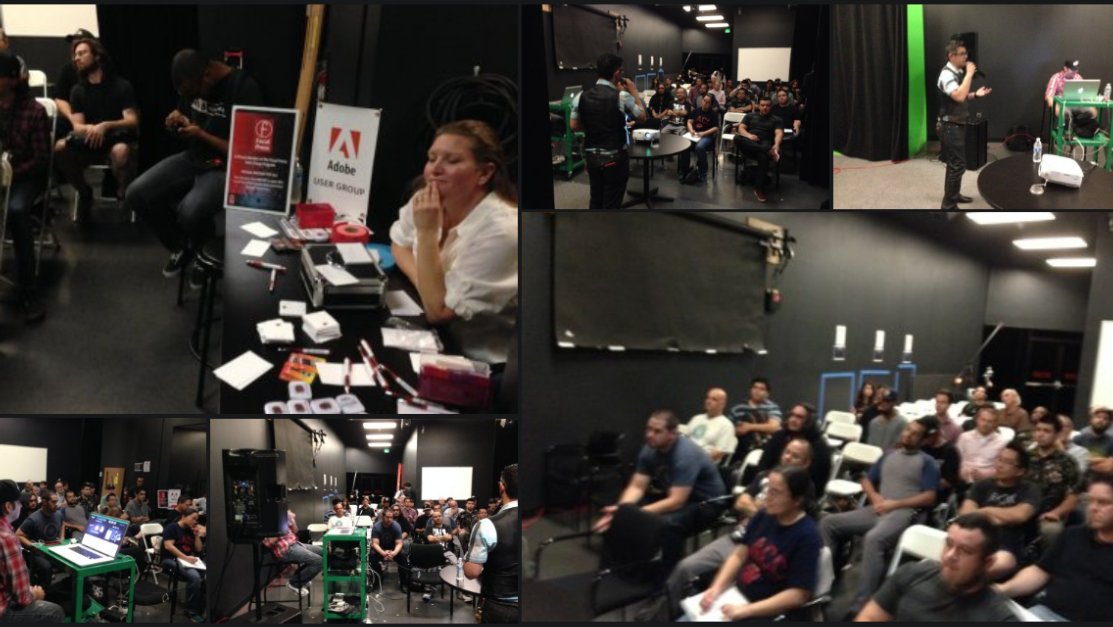
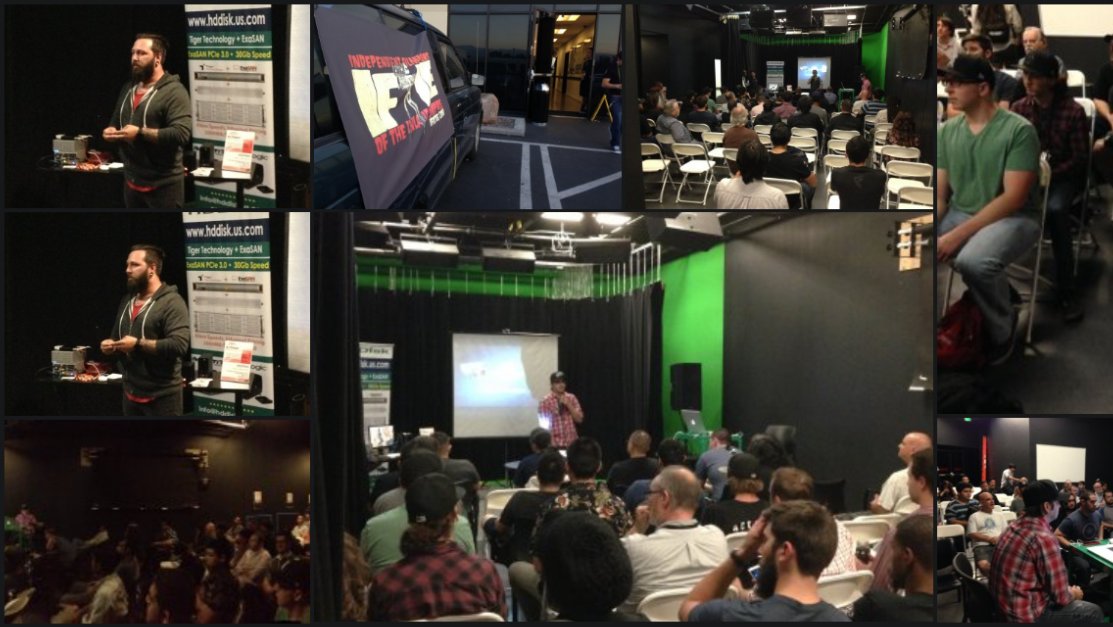
Inspiring night at The Art Institute of California – Inland Empire with Shannon Hartman, Norman Zeledon from HDDisk and Steven C. Miller.

Randy Ubillos at LACPUG 5/27/2015

Thursday, May 28th, 2015

An interesting night at LACPUG, last night.

First a stump the gurus
Randy Ubillos, Larry Jordan, Kylee Wall and Monica Daniels

Two Chicagoans presented last night, as the Blackhawks took game 6 of the NHL Western Conference to tie the series 3 – 3, forcing game 7 to be played in Anaheim. First was Matt Isi Geller who talked about Key Flow Pro, a very cool app that allows file sharing and collaboration in a very unique and smart way. Then Mare Costello who talked about her 5+ year (and counting) journey making The Syriana Tate Interviews. Check both out.

Then a break and then Randy! Randy Ubillos is basically the creator of FCP and ran teams for a number of App creation.

Long time friend and “Head Cutter” of LACPUG, Michael Horton gave a great introduction.

After retiring from Apple, to go on adventures, Randy expressed joy in being able to be here not under the badge of Apple and proceeded to give us a presentation on Making Personal Movies.

He went into tips on making montage videos from trip photos and videos. I won’t show any of the video examples here. You can find the examples on his and his husband’s web page here: http://randyandrick.com/

Doing a “One Man Multicam”

And then his top 10 tips

Overall, Randy is inspiring. He has been able to follow all of his passions and help others to follow theirs, along the way.

He’s democratized editing and creating content for the layman and has helped many people launch careers.

Buddha and Jesus, According to Bob

Friday, May 22nd, 2015

I have here an example of why sometimes it’s great to engage in conversation with your fellow human beings, instead of just sitting in silence, waiting around for something.

Arriving early to the AAA office to register my car, I sat on the planter next to “Bob T.”. At least that’s what the name tag on his trucking company shirt said. Bob was an older Asian fellow (originally from Thailand, I would later find out) who was quick to return a smile and engage in conversation.

Through his heavily accented English, which I knew most people wouldn’t be able to understand, Bob started to talk to me about strange weather we were having and how it was due to the Earth actually spinning slower than normal. He also went on to tell me that because of this phenomenon that this was the reason we were losing planes. The wind was unable to keep up with them as it should and radar tracking doesn’t work right under these conditions. This was not all that was wrong with the planet, it turns out.

Because of it being still cool in May and the varying of hot and cold and hard rain, etc., Bob has had to replant his flowers, over and again. Things were off. Man, you see, is adding more and more chemicals into the environment. These chemicals are seating themselves into the dirt. The dirt and dust that comes down when it rains. (Apparently, that’s why your car gets so dirty when it rains!)

These chemicals are having an effect on humans and animals.

These chemicals are making people more and more easily angered and wanting to fight with one another. That’s why there is such an increase in violence on the planet. It’s not just here in the US. Bob is a world traveler and has witnessed these things in people all over the world.

I asked Bob if there was a solution to this problem. Well, you see, Jesus will be coming around again. We need to make ourselves right for that time.

Bob has made it a point to study religion from many backgrounds. Particularly helpful was an old pastor of his whom recently passed away. I gather he was a born-again Christian type of pastor from the talk we’re having. Bob said that the pastor helped him understand the bible and the different concepts in it. Bob added that I shouldn’t believe what he said but to take these ideas and inspect them for myself and see if they are true for me.

He explained further that it was the falling away from the first five commandments that was leading mankind down the wrong path.

Bob went on to tell me about how Jesus died for our sins so that we could be saved and that the problem Jesus had in his time, was that he fought against the government, fought for people to not pay taxes and preached directly to the common man. Doing so, he made the government angry and that is why they hung him on a cross. Buddha on the other hand took a different approach.

There wasn’t much difference in what Buddha and Christ were teaching. They just took different approaches to spreading their word. You see Buddha went directly to the ruler and sold him on his ideas and because of this was given free reign to spread his teachings amongst its people. So therein, I learned a very important lesson. If you want to reach more people without getting hassle from the Man. You need to go to the top honcho around those parts and sell him on the idea. Then he’ll give you the keys to the kingdom.

And it was at that time, AAA opened for business.

Thanks Bob!

Divergent Media announced today immediate availability of EditReady 1.2 with support for AVCHD and HDV

Friday, March 6th, 2015

Divergent Media announced today immediate availability of EditReady 1.2 with support for AVCHD and HDV camera footage, integrated from their industry leading ClipWrap application. Upgrade pricing is available for existing ClipWrap users.

March 2, 2015 San Francisco, CA – Since its launch in mid-2014, EditReady has quickly gained a reputation as the fastest, easiest transcoding tool on the Mac. With frequent updates, it has gained support for formats like MXF and Sony’s XAVC-L. EditReady 1.2 adds support for hundreds of the most popular cameras which shoot to AVCHD and HDV transport streams.

“By combining the rock solid AVCHD and HDV format support from ClipWrap with the advanced hardware acceleration, GPU filtering and modern user interface of EditReady,” said CEO Mike Woodworth, “we’re one step closer to our goal of a single application for users to prep any footage for edit, dailies, or delivery.”

Consolidating the two products gives EditReady users access to a huge collection of newly supported source cameras. ClipWrap users transitioning to EditReady will be able to take advantage of EditReady’s clean user interface, video preview, metadata editing, and hardware accelerated pipeline.

About EditReady

Rewraps and transcodes HDV and AVCHD, QuickTime, MP4 and MXF input
In addition to the various AVCHD and HDV cameras supported by ClipWrap, EditReady can transcode footage from MXF and Quicktime cameras such as the GoPro, iPhone, Arri Alexa, Blackmagic Cinema Camera, Sony F7, digital SLRs and many more.

Preview videos and see thumbnails
EditReady shows thumbnails of clips for at-a-glance review and organization. GPU accelerated preview allows quick review of footage before transcode and even supports LUTs (look up tables) for simple color correction.

Custom metadata and file naming
EditReady’s metadata editor makes it simple to check the metadata embedded by the camera, correct problems, and add additional info. Any of the metadata can be used to build custom naming schemes for output files.

Fast
EditReady was written from the ground up to use hardware accelerated encode and decode available in many modern Macs, as well as GPU based color transforms. EditReady takes the power and speed of ClipWrap and turns it up to 11.

Availability
EditReady 1.2 is available as a free update for existing EditReady users, and as a $29.95 crossgrade for existing ClipWrap users.

To learn more about EditReady, visit http://www.divergentmedia.com/editready.

About Divergent Media

Divergent Media is a San Francisco, CA based software company providing flexible tools for video monitoring, acquisition, transcoding, and quality assurance. In business for over 10 years, we pride ourselves on making well made tools for video professionals.

2015 – Where Do I/We Go From Here?

Friday, January 2nd, 2015

I talk a lot about trying to find out who I am and what I want to do. So, what does that say about me? I guess I’m unhappy with what I’m doing for a living, overall. A creative stuck in a boring non-creative job. I make up for that lack of “fun” by filling as much of my free time with as many creative things as I can.

Recently, like yesterday, I got some more inspiration from Sue Bryce, of Creative Live fame.

She said some things on her Confront Your Challenges course: https://www.creativelive.com/courses/confront-your-challenges-sue-bryce that really made me think.
(When this airs on CL, you can buy the course and watch it anytime you want.) She was questioning a participant as to whether they really wanted to be a photographer, if they weren’t doing what they needed to do to be one. Then, Segment 10, Emotional Honesty, had me in tears. (Most anytime I hear stories about people doing what they love after being told they can’t, I break down.) I think I have some unresolved issues in that arena!

Anyway, that brought me to this kind of thought process:

For my New Year’s Resolution, “Be the person you want to be. Do the things you want to do.” Well… Then:
Who do I want to be? What do I want to do?

As Sue asked her participant, I ask myself: What do I do for free or spend most of my time doing, that I should be doing as my career?

Outside of my day job, I spend time:
Being with my kids/family
Helping people do what they want to do/Consulting/Advising
Shooting Music Videos
Shooting pictures
Shooting home movies
Writing
Taking Classes
Watching Movies and Television and Videos
Reading Internet Stories or forums
Selling and buying online
Gardening
Traveling
Reef Aquarium Keeping

What I want to do but don’t spend time doing or at least haven’t in the past year:
Editing
Shooting more videos and films
Dekludging my life

What ideas stop me from doing more of the above?
1) Time? (not really)
2) Money? (not really)
3) Thinking that there are already resources out there for people to accomplish the above? (Somewhat)
4) I, also, get side-tracked every time I run into a negative person that I have to deal with. I lose a week or more of creative productivity.

I once worked out for myself, that my job in life was to be a student, I was constantly learning things and figured I’d be doing that for the rest of my life and beyond. So, that is what I concentrated on. I think now that I must adjust that. Especially being a parent. I won’t stop learning but I need to start teaching and not the “those who can’t do, teach” kind of teaching but teach by doing and doing what I do very well.

So, for 2015, I’m upping everything I do.

I’m not sure exactly what that means but these notes are more for me to look over and apprise. So, we’ll see.